Harvard Historical Society
Discover Your Town
The Frozen Water Trade: Ice in Harvard

Severe cold and clear freshwater ponds produced hard, compact, valuable ice for an expanding industry.
Before electric refrigerators, ice was the only way to keep things cool and keep food from spoiling. In the 1800s, ice, harvested in the heart of winter, was the first commercial product of the year for enterprising farmers and businessmen, The first ice business began in Boston in 1805 and expanded greatly after that as various inventions made the harvesting more efficient.
Ice became a mass-market commodity by the early 1830s with the price of ice dropping from six cents per pound to a half of a cent per pound. . Boston’s consumption leapt from 6,000 tons to 85,000 tons during by 1843. Ice harvesting created a “cooling culture” as majority of people used ice and iceboxes to store their dairy products, fish, meat, and even fruits and vegetables.
Our region’s severe cold, coupled with its deep ponds, produced hardy, compact ice that became highly valued for the 19th-century ice trade.
Several ponds were used to harvest ice in Harvard. Bare Hill Pond, the small reservoir off Bolton Road, Cranberry Pond off Old Shirley Road, a pond on Mill Road, and probably others, were sources of ice. Some homes and ice businesses in Harvard had special storage areas where ice was kept insulated in sawdust, lasting well beyond the winter. Before harvesting the ice, any snow was cleared off its surface by a wooden scraper dragged across the ice by a horse. A second scraper was then drawn across the ice, which used a steel blade to scrape away the ice’s porous upper layer, which averaged about three inches. Then another horse dragged a plow across the ice to cut a set of three-inch deep grooves across its surface. Soon after, a series of cuts was made in the opposite direction, creating a checkerboard pattern across the ice.
After the squares were marked off, the manual labor started. Men sawed out rows of ice blocks with hand saws.. Once the first few blocks were removed the work became easier as an ice spade could be dropped into the grooves to pull out the remaining blocks.
In the 1850s ice boxes came into use in homes, with ice delivery men bringing small blocks of ice from storage to homes weekly, even into the summer.
“Harold Whitney lived in the house next to the Congregational Church and across Still River Rd. from us. Every winter he would fill his ice house with ice from Bare Hill Pond and the reservoir on Bolton Rd. It was 14 or 15 inches thick and he would load 15 horse drawn carriages and they would line the street from the pond all the way to his house.”
A Quote from Ellery Eaton Royal’s Diary. Ellery lived at 1 Elm Street.
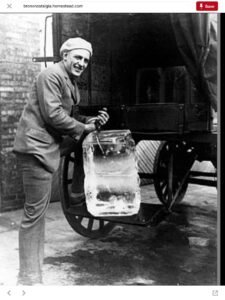
An ice delivery man with fresh ice block.
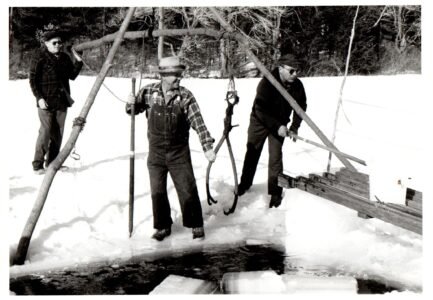
Reenactment of small scale ice cutting on Bare Hill Pond in 1986
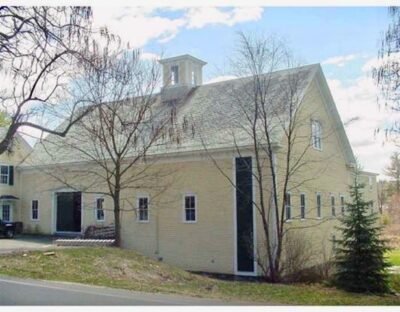
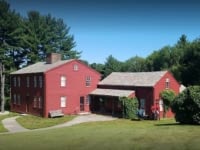
This barn, 7 Still River Road, where Whitney stored his ice, still has the tall ice door that led to the storage room.
More Harvard History and Stories...